
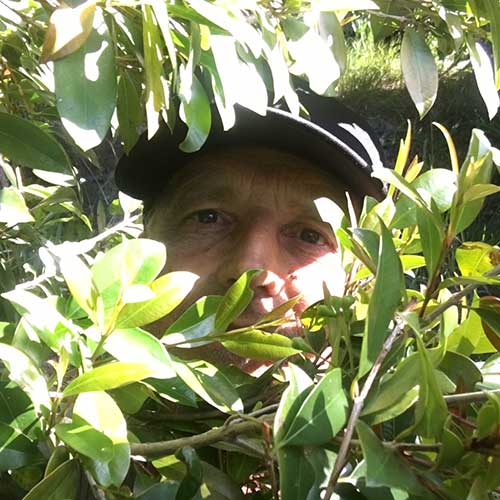

When I first came to Australia from the UK, I had a fondness for the environment but knew virtually nothing about Australian nature. Years later, when I moved from inner city living into a suburban house with a backyard, something special happened. Fascinating visitors such as Blue Tongue Lizards, Leaf Tailed Geckos and Possums provided magical wildlife encounters and my conservation passion, long suppressed, became reignited. As a result, when fragile bushland was threatened by a development nearby, I joined an action group. And, when the local council began planting native plants along a degraded creek line, I started to sit up and take notice.
When the ‘windows of awareness’ gradually began to open up, I realised that I needed to acquire some knowledge of native plants and environmental weeds. I really wanted to plant some genuine natives…and not the hybrid ones with showy flowers that you find in Bunnings. Later I discovered that, in Sydney, each suburb has its own original suite of endemic native plants which are vital in supporting local biodiversity. For example, there are nearly 1,000 wattles (Acacias) native to this continent but less than 30 were endemic to my area.
It subsequently dawned on me that almost every garden in my street had no indigenous plants at all. What was worse, many of the plant species visible, such as Agapanthus, Cotoneaster and Privet were invasive weeds which spread into bushland reserves and actually caused harm. The irony was that none of the local plant shops even sold species which belonged in the area. To find them you had to travel to obscure specialist outlets or wait for the occasional Council native plant ‘giveaway’.
Something had gone horribly awry in this city of Sydney. I realised that the original rich biodiversity had largely been scraped off the face of the earth, just like the indigenous people who once occupied this unique place. Meanwhile the current population seemed overwhelmingly unaware and unconcerned.
Amazingly, the Sydney area has more native plant species than the whole of the UK. They have a subtle, fragile beauty and have evolved both to live on the nutrient poor “Hawkesbury Sandstone” soils and adapt to climatic extremes. But try telling that to the gardening commentators in the media. Unfortunately, growing local natives is not good business as it doesn’t profit multi-national fertiliser, pesticide or horticulture interests.

I realised that my new philosophy was to do the polar opposite of what the so called “Garden Gurus” were advocating. My plan was to remove all “foreign specimens” that were not of habitat value for local wildlife. I would plant species that were endemic to my area (trees, shrubs, groundcovers, grasses); identify any remnant natives and carefully retain them; remove weeds by hand and commit to never using commercial fertilizers, pesticides or fungicides. I might occasionally use a weed killer made up of 99% white vinegar and 1% detergent.
Interestingly, my neighbours remember when my standard “quarter acre” backyard contained only a solitary lemon tree (which was given a stay of execution) and little else. But past decades have seen various plantings and re-growth. The house was built on remnant bushland in the 1920’s and since then suburbia has filled in most of the remaining undisturbed natural areas in the neighbourhood. I often think that what is now happening to the Amazon rainforest in terms of land clearing, happened in this very place, not so long ago.
At this stage I should recommend an excellent book “Field Guide to the Native Plants of Sydney” By Les Robinson, which helped guide my progress. This amazing work contains invaluable information on our native flora including traditional Aboriginal uses for “bush tucker” and medicine.
My garden contained a large lawn area of Buffalo grass, several Radiata Pines, a smattering of eclectic garden species and a few natives. On the edge of the lawn there was actually some naturally occurring native grass Microlaena Stipoedes, some native Geranium (Geranium Homeanum) and some native Violets (Viola Hederacea) plus some naturally occurring Commelina Cyanea (which was eaten by early European pioneers to prevent Scurvy).
A few years beforehand, I had followed the current trend and planted a vegetable garden, but I decided that even this had to go, and it was ultimately replaced by natural vegetation. Luckily there are organic markets nearby for delicious supplies and also a wonderful community garden when I get the urge to plant more veggies.
It’s been a gradual transition but over a few years a large area of lawn has been dug out and the native grass has taken over. A smaller area of Buffalo Grass was replaced with a groundcover called Dichondra Repens.
I no longer have use for a lawn mower! Endemic species of Grevillea, Hakea, Correa, Banksia, Persoonia, Angophora, Eucalyptus, Bracken and Blady Grass etc are growing well and providing food and habitat for wildlife. Additional accommodation has been provided in the form of various nesting boxes.
Insects such as Blue Banded Bees, Mud Dauber wasps and Golden Orb spiders are proliferating. A fishpond has been transformed into a frog habitat which has also spawned an abundance of Spectacular Dragon Flies.
A ban on toxic substances means that butterflies and cicadas can fly around more safely. Caterpillars are allowed to chomp away to their heart’s content. This type of garden requires virtually no watering; falling leaves don’t have to be swept away (as they provide natural mulch) and the local possums kindly provide their own brand of proprietary fertilisers.
I have also converted the “nature strip” of foreign grasses and weeds in the front of the house into a mini habitat area with Lomandras, Dianellas and trees. Again, this is now a mow free zone.
American Gardener and Writer Benjamin Vogt struck a chord with me when he wrote: “We need to stop gardening solely for ourselves and see the incredible, beautiful, soul-magnifying existence that happens when we open up our gardens to the rest of the local environment by using native plants. We believe in giving to the needy and poor of our own species, and to other causes near our hearts, why not the birds, insect pollinators and amphibians in the gardens we supposedly cherish so much?”

As the years go by, the native garden becomes more and more established and only occasional hand weeding is needed. Additional species are occasionally added from a nearby native plant nursery where volunteers propagate tube stock with seed collected from nearby bushland reserves. I sometimes try this myself with mixed results!
The “re-wilded” suburban backyard has provided greater biodiversity, a better connection to nature and more enjoyment whilst it has removed the time, cost, and energy of mowing, fertilizing and “manicuring”. It’s the ultimate “win win” gardening experience!